Jujuy

Country (click to view):  Argentina

Main attractions: a canyon with its tradition and colourful landscapes. The Puna with its high altitude environments. And the Yungas with protected areas where you can appreciate its great biodiversity.
Landscapes of Jujuy

Information about Jujuy

An overview of what to see and do.

It is the northernmost province of Argentina. It is bordered to the north and west by the countries of Bolivia and Chile, and to the south and east by the province of Salta.

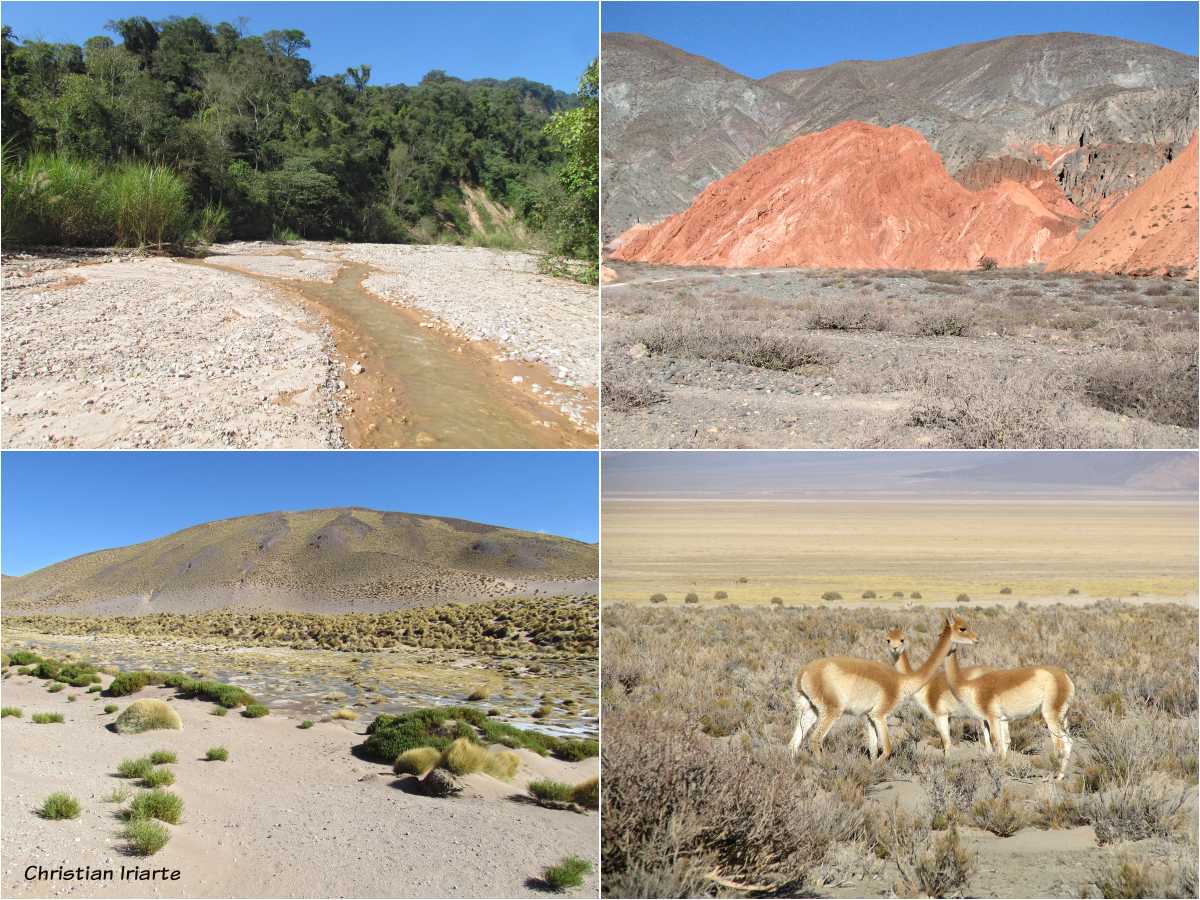
If we move from the northwest of its territory towards the southeast, we will observe great differences in altitude (it has a range of altitudes from 6000 metres above sea level to 500 metres above sea level), climate and relief. Because of this, its territory shows very varied landscapes, and then there are areas with their respective tourist sites:
- Puna: it is a high plateau of the Andes Mountains. Among the places to see is the Laguna de los Pozuelos Natural Monument, where you can observe vicunas and high altitude flamingo species. Another recommended destination is Yavi, which has a museum and is one of the best places to record Puna birds.
- Quebrada de Humahuaca: it is a ravine through which the Grande River flows and has a striking landscape. The main places for tourism are Humahuaca, Purmamarca (which is not exactly in the ravine), Tilcara and Uquía.
- Yungas: it is one of the most biodiverse eco-regions in the country. The Potrero de Yala Provincial Park and the Calilegua National Park stand out, both of which offer trails for hiking.

For those interested in wildlife watching, the variety of environments in this province makes it possible to see a great number of species. And very different mammals, reptiles and birds can be recorded, just by comparing the species found in places as different from each other as the Puna and the Yungas jungle.

Regarding the climate and when to go, it should be taken into account that during the winter (June to September) the weather tends to be colder and drier, and on the contrary, the summer (December to March) is more humid. This is true both in the Andean zone, where rainfall occurs almost exclusively in summer (while winters tend to be cold and with clearer days); and in the Yungas, where although it can rain at any time of the year, it is in summer that the heaviest rainfall occurs.

This route includes lakes/lagoons, salt flats/salinas, mountains, geological formations.

This route includes mountains, rivers, geological formations, temples/monuments.

Destinations to visit in Jujuy

Features rivers, temples/monuments.
Calilegua National Park    Protected areas   Wildlife watching
Features protected areas, forests/jungles, wildlife watching, trails/trekking.
Features temples/monuments, museums, rivers, viewpoints/walkways.
Features rivers, temples/monuments.
Laguna de los Pozuelos Natural Monument    Protected areas   Wildlife watching
Features lakes/lagoons, protected areas, wildlife watching, rivers.
Potrero de Yala    Protected areas   Wildlife watching
Features protected areas, lakes/lagoons, wildlife watching, trails/trekking.
Pucará de Tilcara    Ruins/archaeology
Features ruins/archaeology.
Features geological formations.
Features salt flats/salinas.
Features temples/monuments.
Features rivers, temples/monuments.
Tilcara    Ruins/archaeology
Features ruins/archaeology, museums, rivers.
Features temples/monuments, geological formations.
Yavi    Wildlife watching
Features museums, temples/monuments, wildlife watching, rivers.
Useful link
Tourism:  www.turismo.jujuy.gob.ar
Click the markersto explore